
The brand naming process is a six-step funnel: define the strategy, generate hundreds of candidates, shortlist against agreed criteria, screen the survivors for linguistic and cultural problems, clear them legally, and then make one decision. A typical engagement runs six to ten weeks. The surprise for most founders isn't the steps — it's the ratio: a professional process generates 100–200+ names to end up with one.
That ratio exists because naming is mostly a process of elimination, and the eliminations get expensive the later they happen. Nearly half of all trademark applications filed with the USPTO are rejected — the approval rate has slid to around 52%, the lowest among major markets. A name you fall in love with before screening it is a liability with good typography.
What is the brand naming process?
The brand naming process is the structured method studios use to take a company from "we need a name" to a name that is strategically right, sayable, ownable, and legally available. The defining feature of a professional process is that creativity is the cheap part. Generating names is easy; what you're paying for is the strategy that points the generation in the right direction and the screening that kills the names that would have hurt you.
What are the six steps?
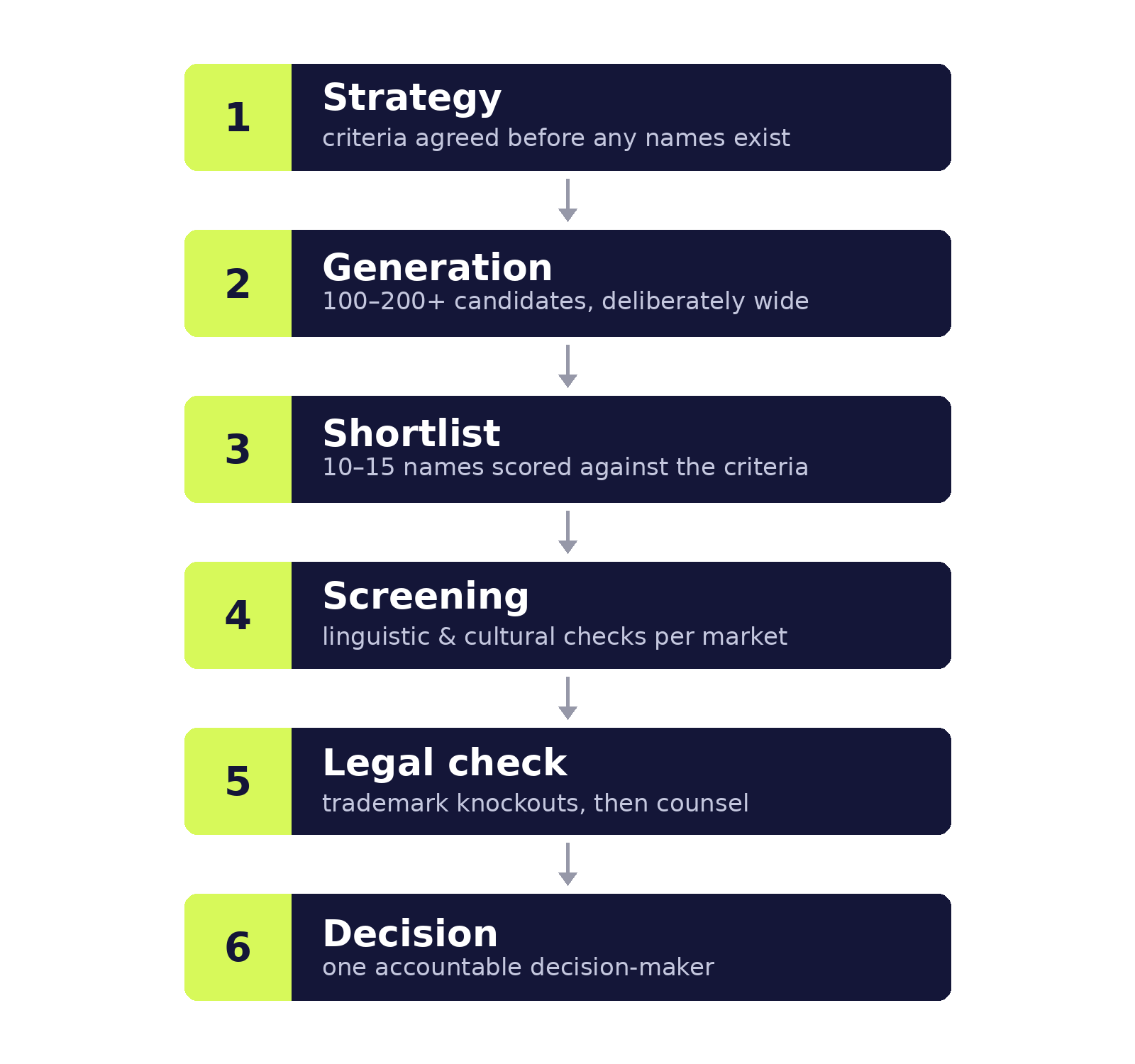
Strategy before syllables. Positioning, audience, competitive audit, and — critically — decision criteria agreed in writing before a single name exists. Most naming disasters are scoring disasters: nobody agreed what a good name had to do, so everyone votes on taste.
Generation. Wide and deliberately undisciplined: real words, compounds, coinages, foreign roots, misspellings. Agencies like Lexicon routinely work through hundreds of candidates here. Quantity is the strategy — your first twenty ideas are everyone's first twenty ideas.
Shortlisting. Names are scored against the step-one criteria, not against gut feel. A shortlist of 10–15 goes forward, each presented with its rationale — why it exists, what it signals, how it sounds out loud and looks in a URL.
Linguistic and cultural screening. Every serious candidate gets checked across the languages and markets you'll trade in: pronunciation, slang, negative connotations, lookalike brands.
Legal clearance. Knockout trademark searches first, then proper counsel on the finalists, in the actual classes and territories you'll operate in. Domains and handles get checked here too — though an exact-match .com is a preference, not a requirement.
Decision. One accountable decision-maker picks from the cleared finalists. Not a poll, not a committee average. Polls reliably select the safest name in the room, and safe is the one thing a name shouldn't be.
Why do most names die in screening?
Because the world is crowded and language is booby-trapped. On the legal side, roughly 70% of US trademark applications receive an initial refusal of some kind, and likelihood-of-confusion with an existing mark is the classic killer. This is why studios run knockout searches early — there is no point falling for a name that a five-minute database search would have eliminated.
On the linguistic side, the corpses are famous. Mitsubishi had to rebrand the Pajero as the Montero in Spanish-speaking markets because of what the name means in slang; Clairol's Mist Stick stumbled in Germany, where "Mist" means manure. Linguistic screening exists precisely because no internal team can hear its own name the way forty other languages will. If you plan to sell globally — and most of our clients do — this step is not optional.
What does a good name actually have to do?
Less than founders think, and more than a brainstorm delivers. A name doesn't need to describe your offering — Apple, Stripe, and Hulu describe nothing. It needs to be distinctive in its category, easy to say and spell after hearing it once, free of fatal associations, and capable of carrying meaning you'll build into it later. Descriptiveness is actually a legal weakness: the more literally a name describes what you sell, the harder it is to protect.
When we named Justach, a men's grooming brand, the winning candidate compressed "just" and "moustache" into one sharp, sayable word — a name that is also a category claim, and one no competitor could plausibly own. That's the test: not "do we like it?" but "could this belong to anyone else?" That thinking is the core of our naming and verbal identity work — the name first, then the tone of voice and language system built around it.
How long does the naming process take?
Six to ten weeks is typical for the studio process — strategy through cleared finalists — with timelines stretching when there are many stakeholders, many markets, or consumer research rounds. Full trademark registration runs on its own clock afterwards: currently around a year in the US from filing to registration. The practical implication: name early. It is the slowest-moving asset in a launch, and the one you least want to change after the packaging is printed.
Naming something soon?
If you're launching, renaming, or stuck at "everything good is taken" — that's exactly the stage we like joining. We run the full process, from strategy to shortlist to screening, and we work with founders and brands globally, fully remote. Start a brief — five minutes, and we'll tell you honestly what your naming project needs.